
Join us
in Efling's social work

Join
Efling's social work!
Efling has a large group of active members who contribute in a variety of ways to promote and support the interests of its members. This group is the key to the good results that Efling has achieved in recent years and intends to continue to achieve.
We encourage you to join us and become part of a great group of active members! Active participation in social work is open to all members and everyone is welcome, regardless of their background.
How can
you participate?
Trustees
Shop stewards play a very important role in Efling's work and the company places great emphasis on increasing their number, as well as providing them with intensive education, training and support. According to collective agreements, Efling members in all workplaces with 5 or more members can elect a shop steward.
A shop steward is the Eflingarfélagi workplace liaison with their union. Their role is to ensure that collective agreements are followed and that laws and rights are respected, and to assist members at their workplace in resolving rights issues when appropriate. The shop steward communicates information from the company to members, and informs the company about the situation at their workplace as needed.
Trustees attend monthly full-day courses from September to May. The courses are ambitious and challenging, yet rewarding and lively. The languages of the courses are English and Icelandic.
The only requirements for a shop steward are that they be a member of Eflinga, do not hold a position of authority with the power to manage/hire other Eflinga members, and have received a confirmed mandate from their co-workers.
If you would like to become a shop steward or assist in appointing a shop steward at your workplace, you can view more information here .
The duties and appointment of trustees are discussed in a special
regulation that the company's board has set.
Board of Trustees
The Board of Trustees exercises supreme authority in the affairs of the association between association meetings. It consists of 130 members, including the board of directors. The term of office of the Board of Trustees is two years, from January 1 of an odd-numbered year to the end of the following calendar year.
Board of Trustees meetings are held once a month during the winter.
The Board of Trustees is discussed in more detail in Articles 15 and 26 of the Association's bylaws , and the appointment of the Board is usually based on a proposal from a nomination committee. Elections are held in November of the second year of the outgoing Board of Trustees' term.
When the election of a new board of trustees approaches, an announcement is usually sent by email to all members, advertised on the association's website and possibly also on other social media. In this announcement, members are invited to nominate themselves.
Serving on the Board of Trustees is a great way to get involved in the affairs of the association and become an active member. The board meetings regularly discuss the status of wage issues and issues that are being discussed in the labor movement. The chairman chairs the meetings and sometimes guests are invited to give presentations. Open discussions are always offered and you are free to raise any issue under the section "Other matters."
Monthly council meetings are usually held in the Efling community center at 6 p.m. on Thursdays. The house opens half an hour earlier and refreshments are served. Meetings are interpreted between Icelandic and English and an effort is made to have material presented translated into both Icelandic and English. See the current council of trustees and meeting minutes here .
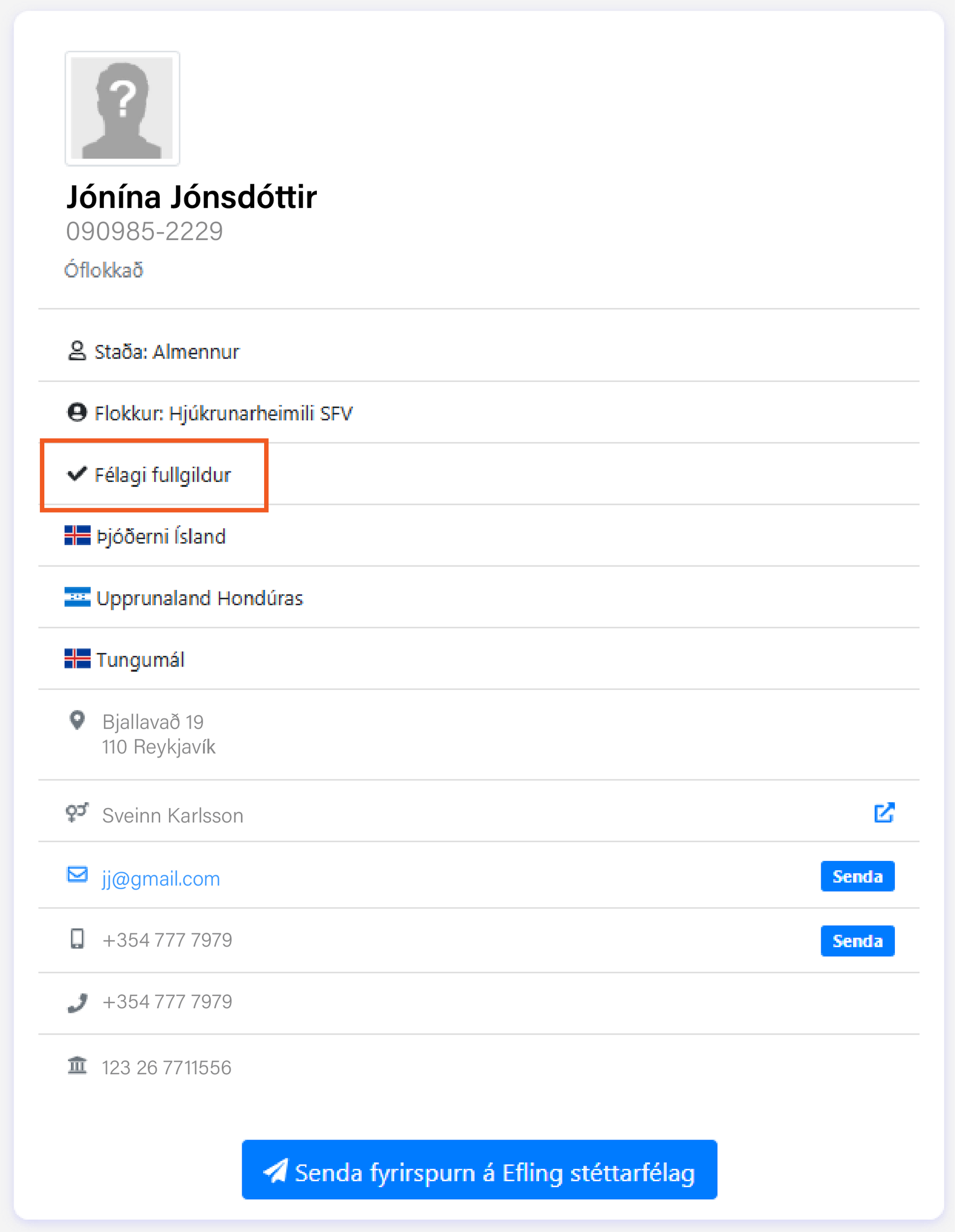
The only requirement that members must meet to be able to run for the board of trustees is to be a full member. Members will automatically become full members after paying dues to the association for 6 months, unless they request otherwise. You can see on your profile page on My Pages whether a member has achieved full membership or not. See image:
Board of Directors and other boards and committees
Efling members have a significant and direct influence on the use of membership funds and the implementation of activities through their membership on the association's boards of funds and standing committees. These boards are key to ensuring that the rights of members are always paramount.
Efling's Board of Directors
The Efling Board of Directors is responsible for the overall management of all corporate affairs between corporate meetings. It is jointly responsible for the company's finances and assets. Board meetings are generally held monthly.
The board consists of 15 members: chairman, vice chairman, secretary, treasurer and 11 co-chairmen. The term of office of the board members is two years and elections are held annually.
To ensure stability in leadership, 7 board members are elected at a time for two-year terms on a rotating basis. The chairman is elected for two years at a time, and the election of the board and auditors takes place annually, no later than the end of March.
The company has a five-member nomination committee that makes recommendations for candidates for the board of directors and auditors. In the selection process, gender and professional equality shall be ensured.
All full members of Eflinga are eligible for elected positions within the association.
The nomination committee's list (A-list) is available at the association's office 8 days before election day. Other candidate lists may be submitted to the election board no later than 7 days before election day. Each list must be accompanied by the recommendations of 120 full members.
Elections to the board are held in writing and by secret ballot at an election meeting or by general secret postal ballot. Members vote between the candidate lists that are up for election.
Further provisions on eligibility, candidacy and election can be found in Chapter VI of the Efling Act.
Other boards and committees
The boards of Efling's funds , including the Health Fund, the Holiday Fund, the Labor Dispute Fund and the Education Fund, along with all standing committees, are generally elected by the company's Board of Trustees and all full members are eligible to vote. This area of responsibility determines which grants are awarded, how the holiday home supply is organized and how education is used. The boards of the funds are thus responsible for implementing the rules set for the funds.
Examples of elected committees and boards include:
- Nomination committee that prepares candidates for the board of directors of Efling.
- An electoral commission responsible for managing general elections and voting.
- Vocational training funds run in collaboration with municipalities, such as the City of Reykjavík.
Guild Council
The Board of Representatives of the Gildir Pension Fund has an important role to play in the affairs of the fund. The Board of Representatives is composed equally of representatives of the employee and employer organizations that support the fund. Trade unions that are members of the fund, including Efling, nominate a total of 80 representatives to sit on the board. The number of representatives of each union, and thus Efling, is determined every other year and depends on the weight of the members' contributions to the fund.
The role of Efling's representative on the Board of Representatives is to vote at Gildir's annual meeting and other meetings, on behalf of Efling. At meetings of the Board of Representatives, the fund's issues are discussed and key performance figures are presented. The board's role is also to confirm nominations of fund member representatives to the fund's board, to elect representatives to the fund's committees, including the fund member nomination committee that prepares candidates for the Gildir board. To determine the remuneration policy and salaries of board members.
To ensure that Efling fund members have a strong voice in the management of Gildi, it is important that as many full members as possible are willing to get involved, but all full members of Efling who meet the eligibility requirements have the opportunity to nominate themselves for a seat on the representative council and thus have a direct impact on the future of their pension rights.
The Gildi representative council is discussed in the fund's articles of association
here .
Seat in the parliaments of the Icelandic People's Federation
The Congress of the Icelandic Confederation of Labour (ASÍ) holds the highest authority in the affairs of the union. It is held every two years and is the forum where the president and central committee of ASÍ are elected. In addition, legislative amendments and resolutions on the union's policy are discussed at the Congress.
Each ASÍ member union has the right to send a representative to the union's congress, and the number of representatives depends on the size of the union. A total of three hundred representatives of employees from all over the country come together to shape the policy and work plan of the overall union and elect its leadership.
All full members of Eflinga have the opportunity to nominate themselves for a seat on the ASÍ parliament and thus have a direct impact on the future of the labor movement. The nomination committee is responsible for arranging parliamentary seats based on nominations and submitting them to a board of trustees, which is responsible for approving the list.
Negotiation committees
Efling's bargaining committees are composed of members and have the important role of leading the company's wage negotiations. Members are advertised for bargaining committees when wage agreements become available and they work until agreements are reached. The chairman of Efling is the chairman of the bargaining committees. The company emphasizes that bargaining committees are large and that their work is open and transparent towards members.
The role of the bargaining committees is to represent the company in the conclusion of collective agreements and they have extensive authority. The committees attend bargaining meetings with counterparties but also hold their own meetings that the chairman calls and chairs. Serving on committees involves considerable work, but committee members may be entitled to attend meetings without loss of pay from the employer. The role of the bargaining committees is discussed in the Efling Act and in the Act on Trade Unions and Industrial Disputes.
Keep an eye on the company's announcements about nominations and elections on the Efling website and via email. To ensure you don't miss anything, it is important to fill out the personal card on My Pages with your email address and phone number.
Please contact us if you have any further questions at
felagsmal@efling.is .